How to Make a New YouTube Channel Legible: The Three Layers of Optimisation
The gap nobody warns you about
A creator I worked with had spent about three weeks on their first four videos. The thumbnails were genuinely good. The edit was clean. The scripts had been rewritten twice.
The videos went nowhere, and the reason was almost boring: nothing about those uploads told the platform what they were for. The titles were clever rather than descriptive. The descriptions were one line. The four videos were about four unrelated things. From the outside, the channel was unreadable.
That is a different problem from “the content is not good enough”, and it has a different fix. Before a video can be recommended to the right person, something has to decide who the right person is. On a new channel, that decision is made with very little evidence, and most of the evidence is supplied by you.
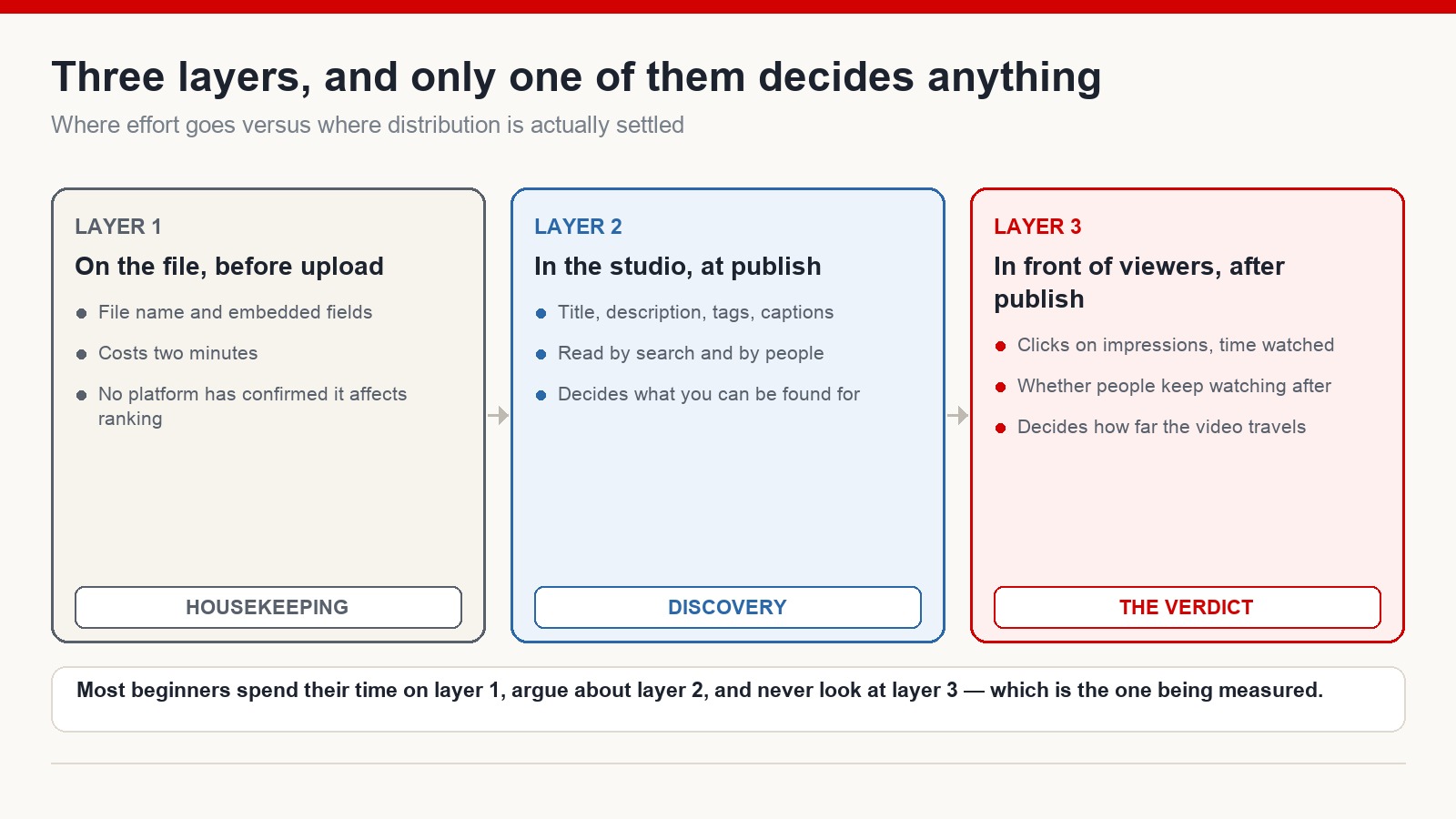
Three layers, and only one of them decides anything
It helps to separate the work into three layers, because people routinely confuse the effort they put into one with results produced by another.
Layer one: the file, before upload
This is everything you can do to the exported file on your own machine — naming it after the phrase you are targeting, filling in the descriptive fields the operating system exposes, keeping your project folders organised around the same vocabulary.
It is often called “raw SEO”, and the honest position on it is this: no platform has ever stated that metadata embedded in an uploaded file is a ranking factor. Treat anyone who tells you otherwise with suspicion. What this layer reliably does is keep you consistent with yourself. It costs two minutes and it stops the target phrase quietly drifting between the script, the file and the upload page. That is a real benefit, and it is a much smaller one than it is usually sold as.
Layer two: the studio, at publish
Title, description, tags, captions, category, the thumbnail. This is what the platform reads and what people see. It decides what you can plausibly be found for.
This layer is genuinely worth care. Not because keywords are magic, but because a video that is ambiguous about its own subject is hard to place, and a video that is hard to place gets shown to a poorly matched audience, who then leave. That is a self-inflicted wound with a real cost.
Layer three: the viewers, after publish
Whether people click when they are shown the video. Whether they stay past the opening. Whether they finish. Whether they go on to watch something else.
This is the layer that actually decides how far a video travels, and it is the only one you cannot write yourself. Most beginners spend their energy on layer one, argue about layer two, and never seriously examine layer three — which is the one being measured.
What layer two is really for
If you accept that framing, the studio fields stop being a keyword exercise and become a description problem: say plainly what this is and who it is for.
Title. The phrase you are targeting should be in it, in wording a person would actually use. If including it makes the title unreadable, the phrase is wrong for the video, not the other way round. A title that reads like it was assembled from a spreadsheet gets skipped in the feed, and being skipped is a much bigger problem than an imperfect keyword match.
Description. Two or three sentences that explain what the video contains, using the target phrase once and its natural neighbours where they fit. Then anything genuinely useful — chapters, sources, what to watch next. Nobody has needed a wall of comma-separated phrases at the bottom for years, and it makes the channel look like it is trying to game something.
Tags. Still worth filling in, still not worth agonising over. A main phrase, a few close variants, a few related terms. Lower case, spelled the way a person types them. Thirty tags do not beat eight relevant ones.
Captions. Underrated. They make the video’s actual language readable, and they help people watching without sound — which is a large share of any feed audience.
The single rule that ties this together: one phrase, carried through consistently. If the file says one thing, the title says another and the description hedges towards a third, you have not covered more ground. You have made the video harder to classify.
The first ten to twenty uploads matter more than the rest
New channels have a specific difficulty: there is no history to reason from. The platform has to guess who to show you to, based on almost nothing.
You make that guess cheap by being boringly consistent for a while.
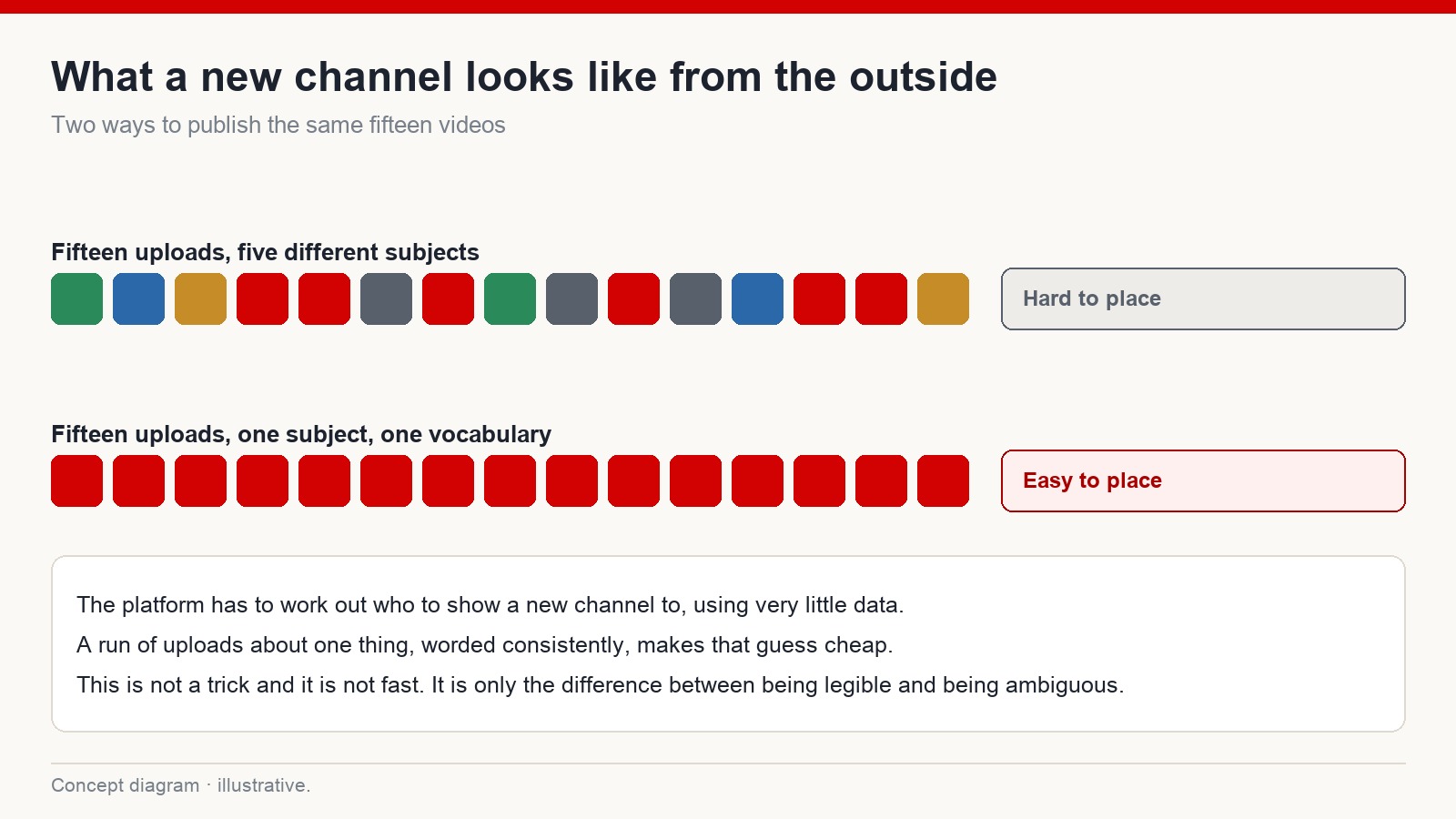
Fifteen videos across five subjects, each with different vocabulary, is a channel that is hard to place. Fifteen videos on one subject, worded consistently, is a channel that is easy to place. Neither is a trick and neither is fast. The difference is legibility.
Concretely, for a first run of uploads:
- Pick one subject and stay in it. Not one broad category — one specific shelf. “Wildlife” is a category. “Slow, quiet wildlife footage for sleep” is a shelf.
- Reuse the same vocabulary. If the audience says “ambience”, do not alternate with “soundscape” because you got bored of the word.
- Put the phrase where it belongs. Title, description, tags, and in the words actually spoken or shown in the video.
- Deliver what the title said. Every time. This is the part that feeds layer three.
- Publish on a rhythm you can hold. Weekly beats a burst of six followed by a month of silence, because a run tells a clearer story than a spike.
After enough of these, the channel stops being a question. That is all “the algorithm understanding your channel” ever meant.
The failure mode: optimising against your own viewers
Almost every serious mistake in this area comes from treating the studio fields as an audience of one machine rather than a room of people.
Keyword-stuffed titles that no human would say. Thumbnails promising a moment the video does not contain. Descriptions written for a crawler. Tags in capitals, scraped from bigger channels.
The uncomfortable part is that some of this works briefly. A misleading thumbnail can lift the click rate for a day. Then people arrive, discover the video is not what they were promised, and leave in the first thirty seconds — and the departure is a much stronger signal than the click was. You have taught the system, accurately, that people who are shown this video do not want it.
The cleanest way to think about it: layer two should make an honest promise, and the video should keep it. Everything else is decoration.
So does the file layer matter at all?
My honest answer is: do it, expect nothing from it directly, and keep the expectation clearly separated from the claim.
Naming files after the target phrase and filling in the descriptive fields takes two minutes per video. It enforces a discipline — you cannot name the file after a phrase you have not chosen yet — and it makes your own archive searchable a year later, which matters more than people expect once you have two hundred exports.
What it will not do is rescue a video nobody wanted, or lift one whose opening loses half the audience. If you have limited time, spend it on the title, the thumbnail and the first thirty seconds. That is where the measurable part of this is decided.
Frequently asked questions
Does metadata inside the video file affect ranking?
There is no confirmation from the platform that it does. Treat it as housekeeping and consistency, not leverage, and be sceptical of anyone who presents it as a ranking factor.
How many tags should a video have?
Enough to describe it accurately — typically a main phrase plus a handful of close variants and related terms. Adding more unrelated tags does not broaden your reach; it blurs the classification.
Should the description repeat the keyword several times?
No. Once naturally in the opening sentences is plenty. Repetition beyond that reads as spam to people, and people are the ones the system is measuring.
How long before a new channel is understood?
There is no fixed number, and it depends on how consistent the uploads are and how much the audience responds. A run of similar videos published on a steady rhythm gets there faster than the same videos scattered across unrelated subjects.
What matters most if I only have time for one thing?
Whether people click and then keep watching. Every field you fill in is upstream of that; none of it substitutes for it.
If you want the full workflow I use for building faceless channels aimed at English-speaking audiences, it is at mmoyoutube.com. Platform behaviour changes over time and outcomes vary between channels.